Replacing Spotify
Table of Contents
I will assume that most people have a story of how they fell in love with music. This one is mine.
My dad had a shelf of CDs in the living room. Motown compilations, Deep Purple’s Burn, Queen’s A Night at the Opera. I would pull out a disc, flip it over, read the liner notes, and put it on. That was the interface.
When I got old enough to have my own taste and no money to fund it, I did what every teenager with a broadband connection did in the early 2000s. Kazaa⧉ first, then Morpheus, then DC++⧉ hubs with ratio requirements that taught me more about networking than any class ever would, then torrents. Everyone I knew did the same thing. We traded 128kbps MP3s over MSN Messenger like the hockey cards of our moment. You would go to a friend’s place before a party and ask them to transfer an album onto your MP3 player while you laced your shoes.
That whole period was reckless in the way that only the early internet could be. I am eternally embarrassed by the time I bricked the family computer trying to download Kickflipper by the Danish artist Razz. Not exactly the peak of teenage taste, and the price of that mediocre taste was a virus that took my dad an entire weekend to chase out of Windows XP. I am not sure what the lesson was supposed to be.
A friend and I once spent an afternoon on a hub waiting for St. Anger to finish downloading. Metallica’s 2003 album, the one a lot of people now perform contempt for with varying degrees of valid argument. Teenage me did not care. The album was fantastic at the time. The irony, given what comes next, is that we were almost certainly stealing it from the band whose drummer had made digital piracy his personal crusade.
Lars Ulrich became famous for that crusade. In 2000, Metallica filed a federal lawsuit against Napster⧉ and three universities, and a few weeks later delivered a list of over 300,000 user names they wanted banned from the service for sharing Metallica MP3s.1 Ulrich testified before the Senate Judiciary Committee that summer.2 Overnight he was the most hated man on the internet, a millionaire throwing a tantrum on behalf of an industry nobody felt sorry for.
Twenty-five years on, the position has aged better than the optics. Ulrich has revisited the topic in interviews many times and consistently lands in the same place: the real damage was not piracy as a moral failing, but the wholesale shift to digital distribution that unbundled the album and gutted the economics that let bands tour, record, and survive between hits.3 The recorded music industry still has not recovered to its pre-Napster peak in real terms, and most mid-tier artists cannot make a living from recordings alone.4 He was obnoxious about it, and his timing made him an easy target, but the core argument turned out to be more or less correct. Devaluing recordings gutted the ecosystem that produces them.
The cruel postscript is that Spotify, the platform that eventually made piracy obsolete, won mostly on convenience. People had not been pirating because it was free. They had been pirating because it was faster and easier than the legal alternatives.5 Once a legal product matched the user experience, the demand for piracy collapsed. There is also a not-quite-buried origin story about how Spotify built that user experience in the first place: by reportedly seeding its early development with a library of pirated MP3s before its licensing deals were fully in place.6 The platform that displaced piracy was, by some accounts, bootstrapped on it.
My main source of music for years was an orange iRiver T10. 512 megabytes of storage, which is roughly one album in FLAC, but in the mid-2000s you could fit a decent rotation of compressed tracks on it. I spent more time curating what made it onto that device than I spend on most professional decisions today. Every slot mattered.
The T10 stayed with me right up until my first smartphone, an HTC Wildfire in 2010. Spotify quietly took over from there. Not overnight, but steadily, the way defaults usually win.
The Spotify years
Swedish company, I am Swedish, it felt almost civic. The promise was simple: everything, everywhere, for a flat fee. And for a long time it was great. I found entire genres I never would have stumbled into otherwise. I built a library of thousands of saved tracks. It became the default background to everything.
At some point, though, I stopped choosing music and started accepting it. The algorithm knows what you have already listened to and gives you more of the same neighborhood. That works, but it is a different activity than listening used to be. More like leaving the TV on than picking up a book.
Why I moved on
A few things accumulated.
Albums I had saved for years would go gray without warning. Licensing deals expire and the catalog shifts underneath you.7 The library I had spent a decade curating turned out to be a renewable lease on a list of links, not a library at all.
Country restrictions added a second tier of unavailability. Tracks I could play in Sweden would vanish abroad and reappear when I came home. Two distinct artists with the same name routinely got merged into one page on the platform, so a niche European band would end up sharing a profile with an American act of the same name, their discographies blended in the same feed for anyone who happened to find them.
The per-stream payouts sit around a third of a cent, which is rough math for independent artists trying to make a living.8 Daniel Ek’s personal investments in defense AI raised some eyebrows.9 AI-generated filler started appearing inside curated playlists, often credited to ghost artists with thin Spotify-only catalogs that exist mainly to displace royalty-bearing tracks.10
None of it was dramatic enough for a boycott on its own. It just gradually stopped feeling like something I wanted to pay for.
The final straw
What pushed me to actually leave was smaller and more personal.
I realised how much Spotify’s interface and recommendation algorithm had quietly reshaped what music I listened to and how I listened to it. Autoplay kept the next track loaded before I had decided whether I wanted one. Daily Mixes and Discover Weekly served me a stable, narrow neighbourhood of taste that mostly reflected what I had already heard. The platform was excellent at giving me a smoothed-out version of my own preferences. It was much worse at letting me have new ones.
I had become a passive consumer of music, which is the polite way of saying I had stopped paying attention. The version of me with the orange T10 had thought hard about every album that made it onto a 512-megabyte device. That person was a conscious consumer of music. The version of me with a phone in his pocket and 100 million tracks on tap had mostly outsourced the choice to an algorithm.
I missed the constraint. I missed caring enough to be inconvenienced.
The DAP
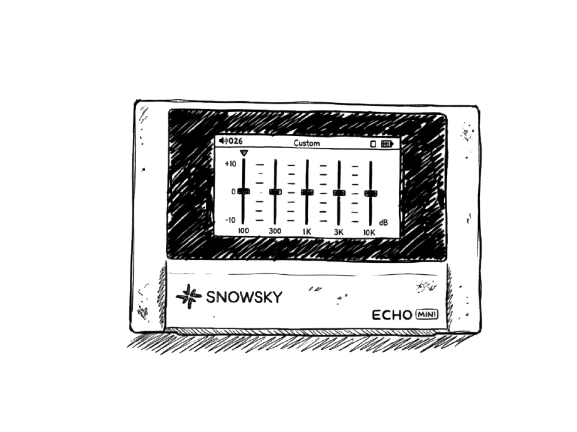
On December 4th, 2025, I got a Snowsky Echo Mini. A dedicated digital audio player. No apps, no account, no recommendations. You put files on it and it plays them. The interface is closer to that iRiver from 2004 than to anything modern, and that turned out to be exactly what I wanted.
DAPs use FAT32⧉ storage, and FAT32 chokes on filenames that Linux is perfectly happy with. Colons, special characters, long paths. They all break on copy. But the real problem is subtler than that. When you copy files onto a FAT32 microSD from Linux, the filesystem stores them in whatever order the OS writes them. The Snowsky has no internal sorting. No alphabetical ordering, no track number awareness, nothing. It just plays files in the order they exist on disk. So if Fedora happens to write track 7 before track 1, that is the order you hear them in. Every album becomes a shuffle playlist by default.
That was the thing that actually made me sit down and write Lyncs. It is a small Lua TUI that scans your music directory, detects mounted microSD cards, sanitizes filenames for FAT32, and writes files in the correct sequential order. That last part is the whole point. Side-by-side view of source and target, batch or individual artist transfers, XDG config. Nothing fancy. It just solved the problem I had.11
Slow music
I buy albums through Bandcamp⧉ now, mostly. Artists keep around 82% of each sale, and on Bandcamp Fridays the platform waives its cut entirely.12 I get lossless files that live on my drive. They do not go anywhere.
The part I did not expect is how much the constraint changes things. When storage is finite and every album on the card is a deliberate choice, you pay attention to the whole record. The sequencing, the pacing between tracks, the arc someone spent months thinking about. That stuff was always there. I had just trained myself to treat it as background texture.
There is something to the idea of slow technology, a term Lars Hallnäs and Johan Redström coined in 2001 to describe tools designed for reflection rather than efficiency: technology that invites time to pass through it rather than compressing it.13 A tool that does one thing, does it without an internet connection, and asks nothing of you in return. The DAP does not know what I listened to yesterday. It does not have opinions about what I should listen to next. It just plays the files. After a decade of algorithmic curation, the absence of suggestions feels almost rude at first. Then it feels like the point.
If you have ever caught yourself skipping through songs ten seconds in, never quite landing on anything, it might be worth asking whether the problem is the music or the delivery mechanism.
I should admit that the years I spent in Sweden running Spotify were also, in parallel, years where I owned a fair stack of vinyl. Honestly, most of it was bought for the novelty. The records mostly sat there looking handsome. The single honourable exception was my copy of Fleetwood Mac’s Rumours, which earned its keep as the clean-the-house album and still does.
The shelf is back, for real this time. It just lives in my music folder now, with rmpc talking to MPD at home. And on the go, I have my trusty DAP.
Footnotes
-
A&M Records, Inc. v. Napster, Inc. was filed in 1999; Metallica filed its own federal suit against Napster and three universities in April 2000 and shortly after submitted a list of over 300,000 user names for termination. See the Wikipedia summary of Metallica v. Napster and contemporaneous reporting in MTV News, Salon, and Rolling Stone, May 2000. ↩
-
Lars Ulrich testified before the Senate Judiciary Committee on 11 July 2000 at the hearing “Music on the Internet: Is There an Upside to Downloading?” The prepared statement is preserved in the Congressional Record and widely reprinted. ↩
-
Ulrich has revisited Napster repeatedly in interviews, including in Rolling Stone (2020, twenty-year anniversary of the lawsuit), The Howard Stern Show, and WTF with Marc Maron (August 2019), where he argued that the lawsuit was about the loss of artistic control over distribution rather than about money. ↩
-
Global recorded music revenue peaked at $23.3 billion in 1999 (IFPI). Adjusted for inflation, the industry did not approach that figure again until the early 2020s, and the revenue now flows primarily to platforms and major labels rather than working musicians. ↩
-
Aguiar, L., and Waldfogel, J. (2018). As streaming reaches flood stage, does it stimulate or depress music sales? International Journal of Industrial Organization, 57, 278-307. The paper, along with the IFPI’s Music Consumer Insight Report series, documents the steep decline in piracy as paid streaming displaced it. ↩
-
Eriksson, M., Fleischer, R., Johansson, A., Snickars, P., and Vonderau, P. (2019). Spotify Teardown: Inside the Black Box of Streaming Music. MIT Press. The book documents Spotify’s early reliance on pirated MP3 files during pre-licensing development. See also TorrentFreak’s 2017 reporting on the same. ↩
-
Albums regularly disappear from Spotify when licensing agreements lapse. See discussions on r/spotify and music industry reporting throughout 2024-2025. ↩
-
Spotify per-stream payouts documented by The Trichordist and United Musicians and Allied Workers. Rates vary by region and account type. ↩
-
Daniel Ek’s investment in Helsing reported by Financial Times, March 2024. ↩
-
Liz Pelly’s reporting on Spotify’s “ghost artist” program in Harper’s Magazine, January 2025, expanded in her book Mood Machine: The Rise of Spotify and the Costs of the Perfect Playlist (Atria/One Signal, 2025), documents Spotify commissioning low-cost stock-style tracks attributed to fictional artists to displace royalty-bearing music inside curated playlists. ↩
-
The one thing the setup lacks is scrobbling⧉. I still use MusicBrainz⧉, ListenBrainz⧉, and CritiqueBrainz⧉ when I have the time. Having listening history feed into that ecosystem would be nice, but it is not a dealbreaker. ↩
-
Bandcamp revenue split: artists receive approximately 82% on standard sales. Bandcamp Fridays waive the platform’s share entirely. ↩
-
Hallnäs, L., and Redström, J. (2001). Slow technology: Designing for reflection. Personal and Ubiquitous Computing, 5(3), 201-212. The foundational paper coining the term, from the Swedish HCI tradition that the rest of “calm” and “ambient” computing later borrowed from. ↩