The Case for a Commonplace Notebook
Table of Contents
In the previous post I made the case for a Markdown-based journal as the spine of a personal system. That setup still holds. It has one weak point though, and no plugin fixes it: capture. The seconds between “I just had a thought” and “I have opened the right note in the right vault” are where most thoughts get lost. A physical notebook closes that gap in a way digital tools cannot.
I keep one within arm’s reach at all times. The format has a long, slightly pretentious history under the name commonplace book: a single bound volume used to collect quotes, observations, fragments, and whatever else has not yet earned a permanent home.1 In practice mine is whatever it needs to be on a given afternoon. A scratchpad, a planner, a flowchart, a doodle page, a meeting log.
There is also a retention argument worth mentioning, because it is the part most people skip. Mueller and Oppenheimer’s 2014 study on laptop versus longhand note-taking found that students who took notes by hand performed measurably better on conceptual questions, because typing tends to produce verbatim transcription while handwriting forces summarisation in real time.2 Longcamp and colleagues had shown something similar at a neurological level years earlier: handwriting recruits motor regions that typing simply does not, and that mattered for letter recognition in early learners.3 You do not have to take any of this on faith. Write down the next thing you want to remember and see whether you remember it a week later.
What I actually use it for
The mistake is to treat a notebook like a journal. It is not. It is a buffer between the world and the rest of the system. A few things I lean on it for, in roughly the order they come up in a normal week:
- Catching anything I need to remember later. I jot it down and box it in on the most recent page so it survives the next two hundred pen strokes. Boxed corners are easier to thumb back to than underlines.
- Planning the day when I feel overwhelmed. I list everything out, then reshuffle priorities with arrows in the margin instead of rewriting the list. Most of the value is in writing the list. The rest is in the arrows.
- Sketching software systems. Boxes, arrows, data flow, state machines, sequence diagrams, the occasional ERD. Whiteboarding for one. The page is small enough to force a diagram I can actually reason about, and there is no tool palette to fiddle with instead of thinking.
- Following along in calls and online meetings. Handwriting does not derail the conversation the way a keyboard does, and I can sketch what someone is describing as they are describing it.
- Mindmapping when a problem has too many branches to hold in my head. Centre the question, let the branches go where they go.
- Marking the date of something I want to revisit, then actually revisiting it on a later page when the time comes. The notebook becomes its own slow-motion task queue.
- Interstitial notes, occasionally. Short timestamped lines to see how long something really took and to hold myself to the result I said I was aiming for. Useful tool, not the point of the exercise.
Doodling counts
Sometimes I just doodle. Aimless shapes, ugly perspective sketches, whatever pulls me away from the screen for a minute. It looks unproductive and is the opposite. Talking through a problem with the notebook beside me is rubber-duck debugging where the duck happens to take notes. The hand keeps moving while the head untangles.
A few simple techniques
None of these are mine. All of them are old, simple, and work better than they have any right to.
- Date and title every page at the top. Even a notebook becomes hard to search once it crosses a few hundred pages. Two seconds at the start of a session pays back in months.
- Number the pages and keep a one-line index at the back. Walter Pauk’s Cornell note-taking method has been doing a version of this since the 1950s and it still beats most digital indexing.4 Entries do not need to be clever. “p. 142, auth rewrite sketch” is enough.
- Colour-code by concern, not by aesthetic. If you do reach for a second pen or a coloured pencil, give each colour a job and stick to it. One for action items, one for ideas, one for things you owe somebody else. Reviews of the colour-and-memory literature consistently find that colour acts as a recall cue, especially for categorical information.5 Keep the palette small. Two or three colours is plenty, and more than that just slows you down at capture time.
- Use signifiers in the margin. A dot for a task, a circle for a meeting, an exclamation mark for something urgent, a small box around anything you must not lose. This is the rapid-logging idea behind Ryder Carroll’s Bullet Journal method, stripped of the brand.6 Once your eye learns the symbols, scanning a page takes a second.
- Leave white space on purpose. A page that is full edge to edge is a page you will not reread. Margins are not waste, they are where your future annotations live.
The pattern across all of these is the same: pre-commit to a small visual vocabulary so your future self can find things without rereading the whole notebook. Keep the vocabulary smaller than you think it needs to be. Five signs you use every day beat twenty you forget.
What I use
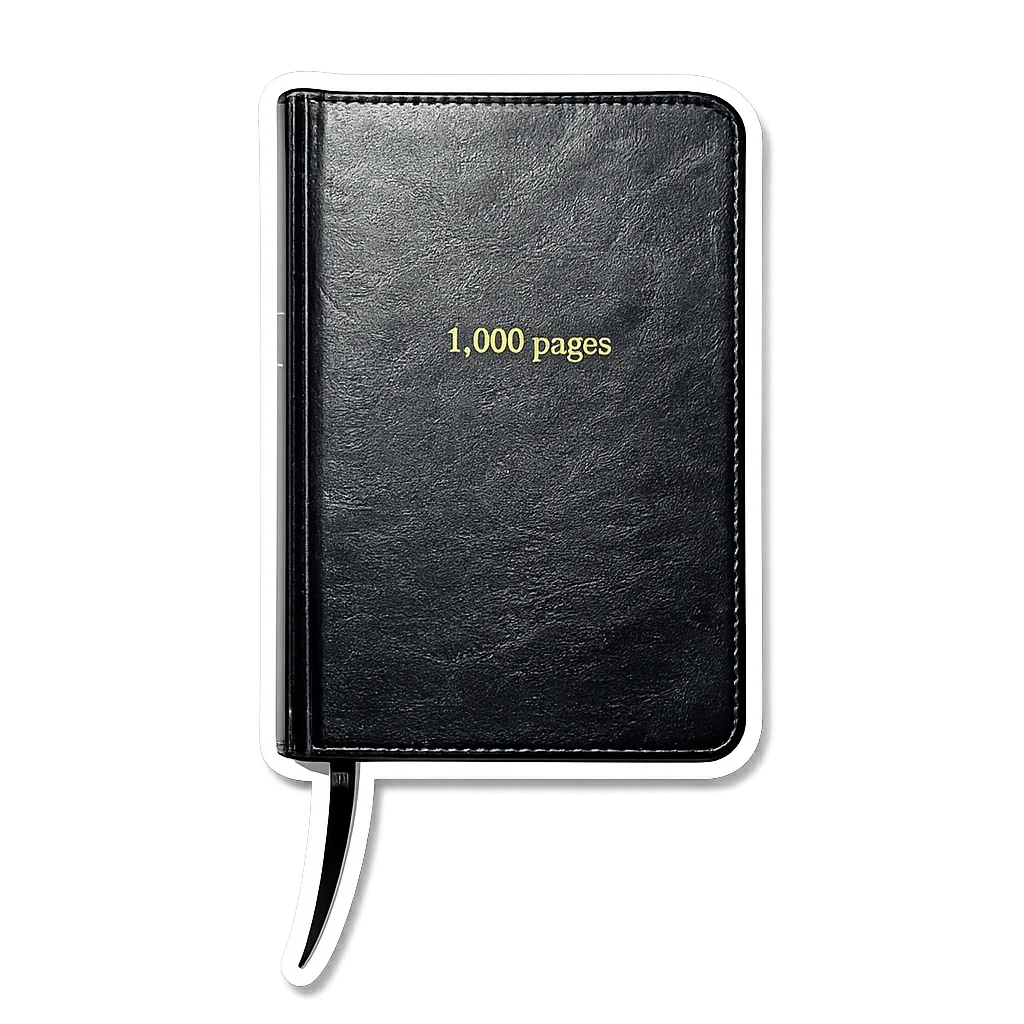
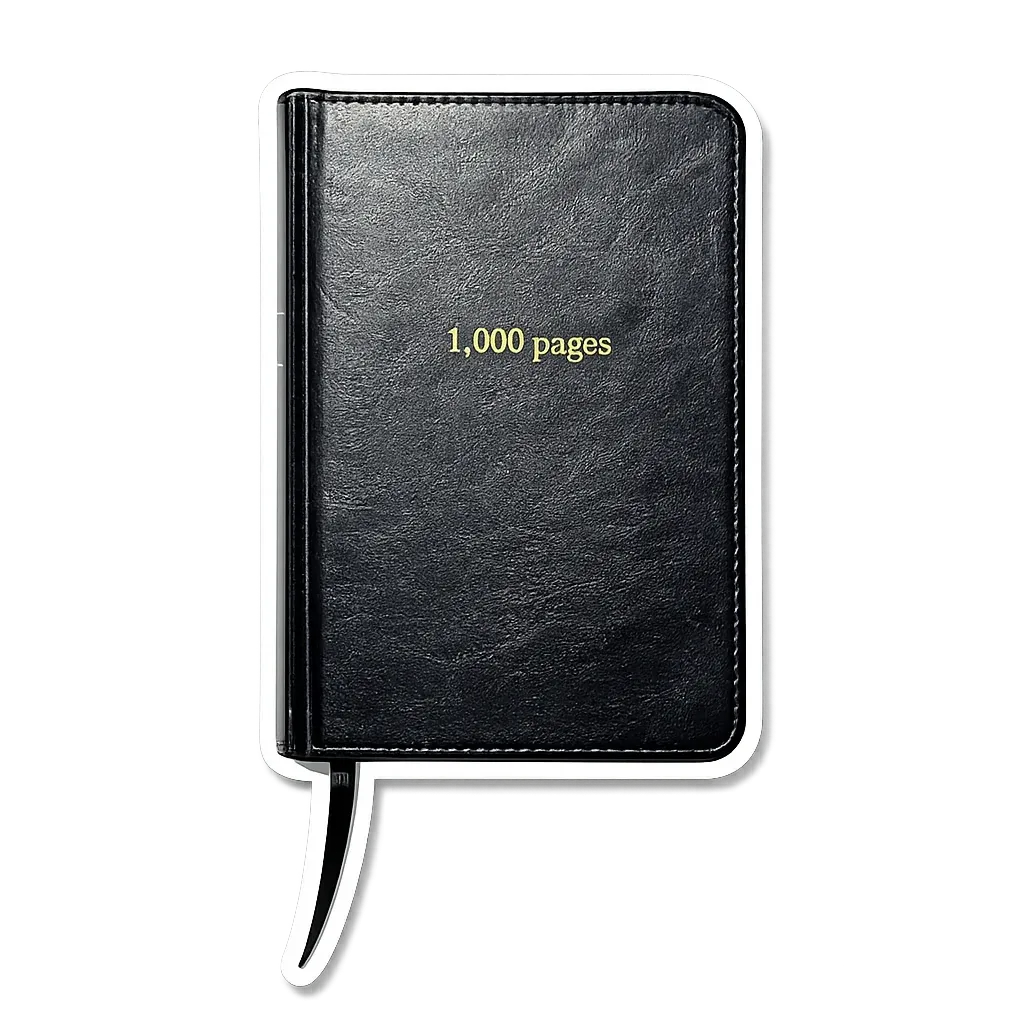
I went with the Milimetrado 1000, a thousand-page notebook from Curiosite in Portugal. I wanted to see how many pages I could reasonably carry around in a laptop bag. A thousand, it turns out, with a bookmark ribbon so the next blank page is never more than a thumb away.
The pages are “bible thin” but take pen, pencil, and the occasional marker without bleed-through worth complaining about. It is a slightly ridiculous object, which is part of why I like it.
The only rule
Develop a relationship with whatever you carry. Page size, grid versus blank, binding, pen. None of it matters as long as it is the same one every day and it goes wherever you go. The notebook is infrastructure. You do not want to be making decisions about it in the moment.
Do not underestimate the tactile utility of physical notetaking. The hand is faster than the menu.
Footnotes
-
John Locke kept one. Marcus Aurelius’s Meditations was, in effect, a published commonplace book. The format predates the productivity blog by a few millennia. See Moss, J. (2016). Commonplace Books: A History of a Reading and Writing Practice. University of Delaware Press. ↩
-
Mueller, P. A., and Oppenheimer, D. M. (2014). The pen is mightier than the keyboard: Advantages of longhand over laptop note taking. Psychological Science, 25(6), 1159-1168. https://doi.org/10.1177/0956797614524581 ↩
-
Longcamp, M., Zerbato-Poudou, M.-T., and Velay, J.-L. (2005). The influence of writing practice on letter recognition in preschool children: A comparison between handwriting and typing. Acta Psychologica, 119(1), 67-79. https://doi.org/10.1016/j.actpsy.2004.10.019 ↩
-
Pauk, W. (1962). How to Study in College. Houghton Mifflin. The Cornell note-taking method, including a margin cue column and an end-of-page summary, was first formalised here. ↩
-
Dzulkifli, M. A., and Mustafar, M. F. (2013). The influence of colour on memory performance: A review. Malaysian Journal of Medical Sciences, 20(2), 3-9. https://pubmed.ncbi.nlm.nih.gov/23983571/ ↩
-
Carroll, R. (2018). The Bullet Journal Method: Track the Past, Order the Present, Design the Future. Portfolio. The system was first documented publicly at bulletjournal.com around 2013. ↩