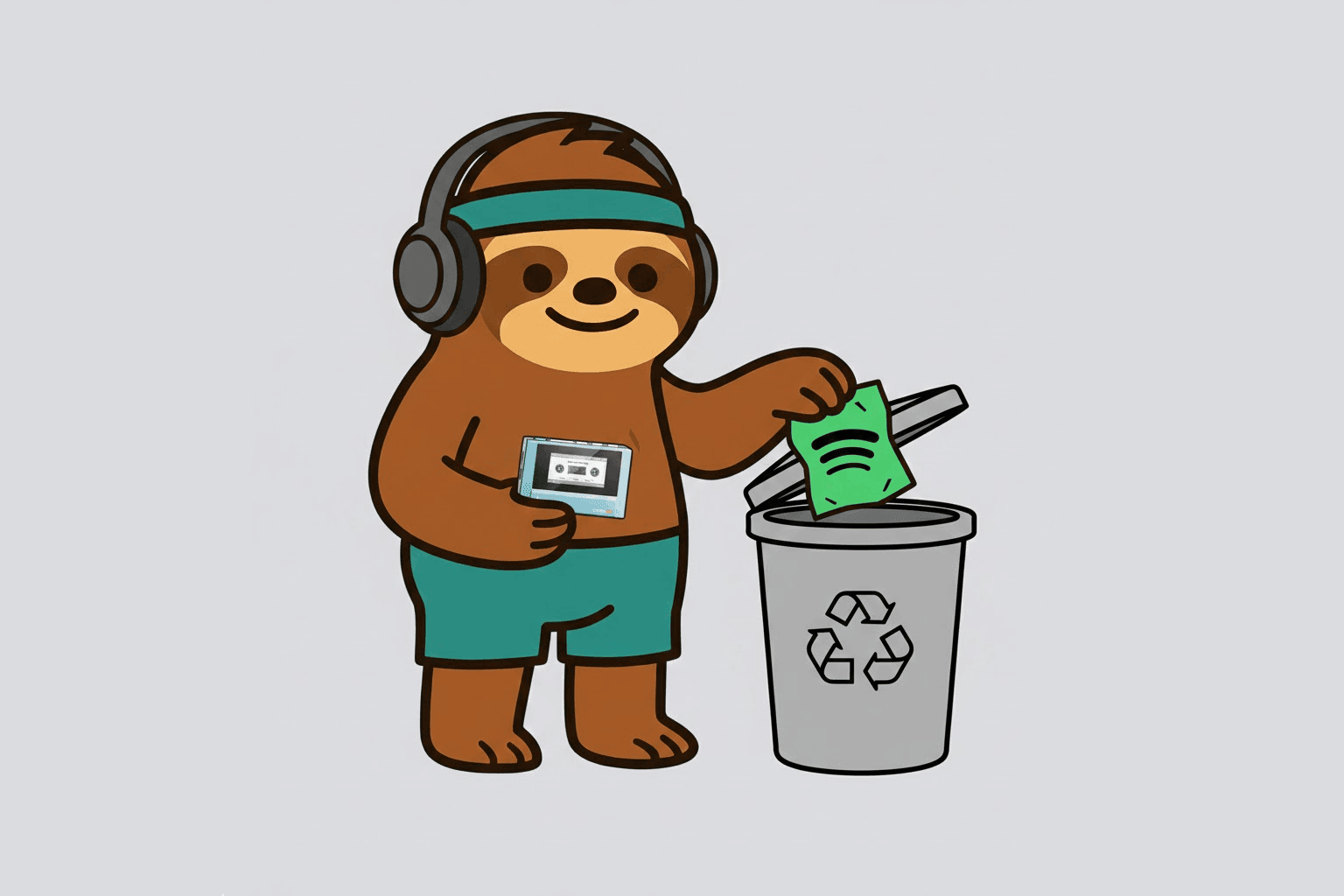
Got my DAP
Table of Contents
I got Spotify very early. I was still in college. I might have even installed it on my very first smartphone, the HTC Wildfire. It beat the convenience of piracy and for a long time it was lauded for exactly that. No more torrenting, no more sketchy downloads. Just press play and it’s there.
And it caught me.
The slow frustration
But even in the very beginning it was frustrating. You’d spend hours crafting the perfect playlist, building something that told a story from track to track, and then one day you’d be listening and something just felt off. A track was skipped. You check, and there it is: “This song is no longer available in your region.” Gone. No warning, no explanation, no alternative. Just a greyed-out line where your favorite song used to be.
This happened over and over again, for years, across every playlist I cared about. And every time it stung a little more.
You will own nothing
Here’s the thing about streaming: you don’t own anything. Not a single track. You’re renting access to a catalog that can be altered, reduced, or removed at any time and you have zero say in it. The phrase “you will own nothing and be happy” has become a meme at this point, but when it comes to digital media it’s literally what happened.
We went from a world where you bought a record, a tape, a CD, a digital file, and it was yours forever, to a world where you pay a monthly fee for the privilege of maybe hearing what you want to hear today. DRM makes sure you can’t keep any of it. Cancel your subscription and everything vanishes. Every last song.
That’s not ownership. That’s a lease with terrible terms.
What it does to artists
And it’s not just bad for listeners. It’s atrocious for the people making the music. Spotify pays somewhere between $0.003 and $0.005 per stream. In 2024, they introduced a 1,000-stream threshold below which artists don’t get paid at all. That policy alone reportedly withheld around $47 million from small independent artists and redistributed it to bigger acts.
Meanwhile, the platform has been caught filling playlists with stock music from ghost artists to reduce royalty payouts. Swedish newspaper Dagens Nyheter found that around twenty songwriters were behind the work of more than five hundred fake “artists” whose tracks had been streamed millions of times. Spotify calls this “Perfect Fit Content.” Everyone else calls it what it is.
And then there’s the CEO, Daniel Ek, pouring $702 million into AI-powered combat drones while songwriters can’t pay rent. Artists have been leaving the platform in droves throughout 2025. Massive Attack, King Gizzard, and a growing wave of indie musicians have all pulled their catalogs.
The algorithm got me
But honestly? What actually broke me wasn’t the politics or the payouts. It was what the algorithms did to my listening habits.
I used to take music VERY seriously. I was the guy digging through obscure bands, buying records at shows, building my taste one discovery at a time. That’s who I am.
But Spotify’s recommendation engine is patient. At first it was just annoying. Redundant pop artists showing up in my Discover Weekly, easy to ignore. But over time it built a profile on me. It figured out the kind of pop it could market to me specifically. And it kept pushing it into custom playlists, over and over and over again, until the last couple of years I realized I’d just been stuffing myself with vapid muzak. Background noise dressed up as personal taste.
I no longer felt like the rebellious counterculture person who cared deeply about what I listened to. Yet I know I still am that person. The algorithm just buried him under a mountain of curated mediocrity.
The DAP
So I put my foot down and bought a DAP.
The FiiO Snowsky Echo Mini in cyan. It’s a tiny dedicated music player with dual CS43131 DAC chips, both 3.5mm and 4.4mm balanced outputs, support for DSD256 and 24-bit/192kHz FLAC, a microSD slot for up to 256GB, Bluetooth 5.3, and about 15 hours of battery life. It looks like a tiny cassette player. It cost less than $50.
It plays the files I put on it. No algorithm, no recommendations, no “This song is no longer available.” Just music.
The quirks
It’s not perfect. You can’t scrobble from it. It doesn’t even keep an internal listening history. That might show up in a firmware update someday, but for now you’re flying blind on stats. A man can dream.
The other thing is that you need to load albums using software because the player sorts files inside folders by “date added.” If you just throw files in there haphazardly it’ll jumble your albums into an incoherent mess. Annoying thing to have to be mindful about, but you learn the workflow.
Paying for music again
And yes, I pay for music now.
When the news broke that Tomas “Tompa” Lindberg died in September 2025, I went straight to Bandcamp and bought Live The Storm by Disfear. Tompa was the vocalist of At The Gates, one of the most important melodic death metal bands to ever exist, and his run with Disfear produced some of the best d-beat punk ever recorded. That album was recorded by Kurt Ballou at God City Studios. It’s perfect. Tompa was 52.
Buying that record felt right in a way that adding it to a playlist never would have.
Support the ecosystem
Bandcamp is the best thing that’s happened to independent music in years. Artists get the majority of the sale. You get a file you own forever. No DRM, no subscription, no disappearing tracks. It’s how buying music should work.
And if you care about tracking what you listen to, ditch Last.fm and move to ListenBrainz. It’s open source, community-driven, and ties into MusicBrainz, which is the most comprehensive open music database out there. Use these tools. Explore music with hunger. Dig for things that algorithms would never show you.
Slow down. Be conscious about what you listen to. Own your music. The artists making it deserve that much, and so do you.